Features
Hire better.
Build stronger teams.
Start with hiring, add talent intelligence, and gain workforce insight across the full employee journey.
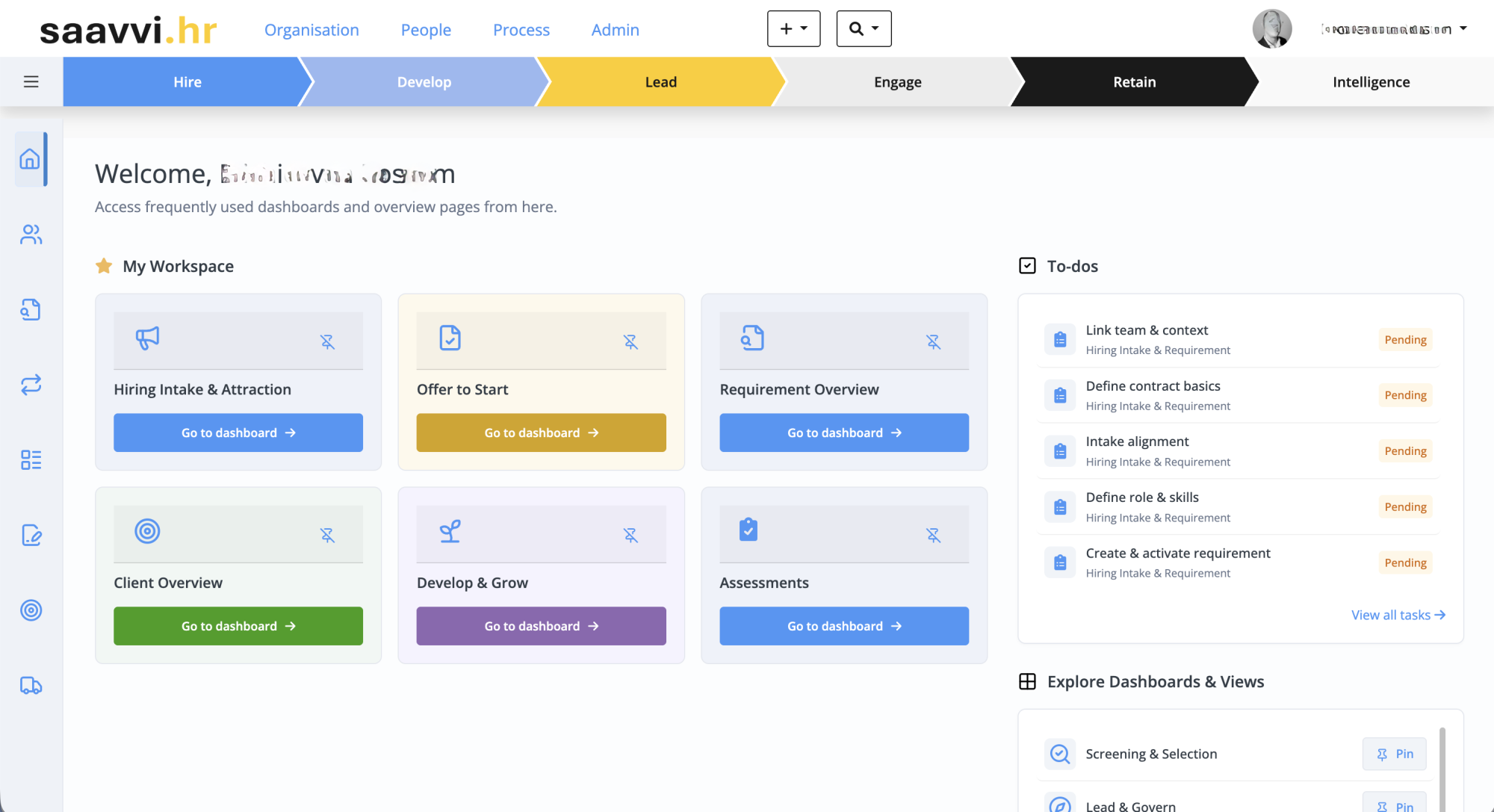


Platform overview
One connected HR platform.
Core
People Module, requirements, AI matching, workflow & tasks, contract handling, portals, dashboards, document handling and multilingual UI.Boost
Advanced workflow builder, custom assessments, dropdown configuration, manager views and other extensions that help teams fit the platform to their process.Open platform
Connect
Integrations that extend the platform into payroll, ERP, learning, documents, assessments and communication tools.
Hire
Reduce time-to-fill and improve team fit.
Start with hiring as the clearest entry point, then keep role requirements, people context and decision flow connected.
Onboard
Shorten time-to-productivity with structured follow-through.
Keep the bridge between candidate acceptance and early productivity visible instead of splitting it across disconnected tools.
Develop
Improve visibility across skills, roles and future mobility.
LEAD
Give managers better context and clearer next actions.
Translate people information into visible actions, approvals and follow-up instead of static reporting alone.
Engage
Keep employee touchpoints visible across the journey.
Retain
Maintain continuity after the initial hire.
Make ramp-up, exits, open tasks and long-term follow-up part of the same operating model.
Intelligence
Support faster decisions with shared dashboards and exports.
Analytics become more useful when they sit next to workflow, follow-up and shared context.
Workflow proof
Proven workflow templates delivered in Core.
Delivered in Core
Hiring intake & requirement definition
Align urgency, define role and skills, link team context and activate the requirement.
Delivered in Core
Screening & shortlisting
Screen profiles, review matching pre-score and create a more structured shortlist.
Delivered in Core
Interview & evaluation
Prepare interviews, capture notes and scores and support consistent next steps.
Delivered in Core
Offer & decision management
Draft details, generate contracts, send offers and record outcomes.
Delivered in Core
Preboarding & onboarding
Collect details, prepare documents, coordinate access and guide day one.
Delivered in Core
Ramp-up & time-to-productivity
Track 30-60-90 goals, early progress and manager follow-through.
One connected HR platform
How the modules work together.
One talent record
Keep applicant, employee and future workforce context linked instead of duplicating data across tools.
One workflow logic
Reuse task, approval and lifecycle structure across hiring, onboarding and retention journeys.
One management cockpit
Bring dashboards, open tasks, requirements and people insight into role-based views.
One modular architecture
Start with Core and expand through Boost and Connect as needs evolve.
Integrations
Connect the platform to the rest of your HR stack.
Connect
Payroll & ERP
Support handoffs and sync scenarios with payroll and ERP systems without turning the page into a payroll-first story.
Connect
Documents & learning
Extend journeys where document lifecycle or learning delivery needs deeper support.
Connect
Assessments & comms
Bring assessment providers and communication tools into the broader workflow model.
Connect
Open platform logic
APIs and ecosystem integrations reduce rip-and-replace pressure and let teams keep systems of record that already work.
Security & trust
Keep privacy and control visible.
Role-based access
Support different user groups with views and actions that match their responsibilities.
Privacy-aware design
Show GDPR-conscious handling, secure workflows and controlled visibility without drifting into legal overload.
Audit-friendly workflows
Keep approvals, actions and structured process steps easier to review.
Multi-entity support
Support teams, departments, locations and multilingual growth across more complex organizations.
Outcomes
Turn hiring into measurable business outcomes.
Operational outcomes
Reduce manual HR coordination.
Improve time-to-fill.
Shorten time-to-productivity.
Manager outcomes
Improve follow-up visibility.
Clarify next actions.
Support better adoption.
Decision outcomes
Faster reporting.
Better workforce insight.
More role and entity visibility.
Commercial bridge
Shift the page from “what the platform has” to “what better HR operations look like”.
FAQ
Answer real buying questions.
Can we start with one module?
Yes. The platform story is strongest when teams start where urgency and ROI are clearest, then expand into adjacent workflows and capabilities over time.
What is included in Core?
Use Core as the ready-to-use foundation: people, requirements, AI matching, workflow & tasks, contract handling, portals, dashboards, document handling and multilingual UI.
Which integrations are available?
Use Connect to position payroll, ERP, document, learning, assessment and communication integrations without overclaiming native breadth.
Do you support multi-entity organizations?
Yes. Multi-entity structure and organizational visibility should be positioned as part of the platform’s suitability for more complex HR environments.
Can workflows be configured to our process?
Yes. Use Boost and implementation scoping to explain where teams can adapt workflow logic, fields, approvals and broader process design.
Is the platform multilingual?
Yes. Keep multilingual support visible early on the page because it immediately signals platform readiness for broader organizational use.
How quickly can we go live?
many organizations start with a preconfigured Core setup and expand over time based on scope, workflow choices and integrations. Core setup is fast.
